All rivers . . . return to the sea.

One will suffer the whole year for not plowing well in spring .
One will suffer for life for not educating the children well.
A single brick does not make a wall.
A single flower does not make it spring.

All rivers . . . return to the sea.
One will suffer the whole year for not plowing well in spring . One will suffer for life for not educating the children well.
A single brick does not make a wall. A single flower does not make it spring.
Sequence and Progression in Linked Verse and Other Japanese Poetry:
Aesthetic Sensibilities of Makoto Ueda (1931-2020)
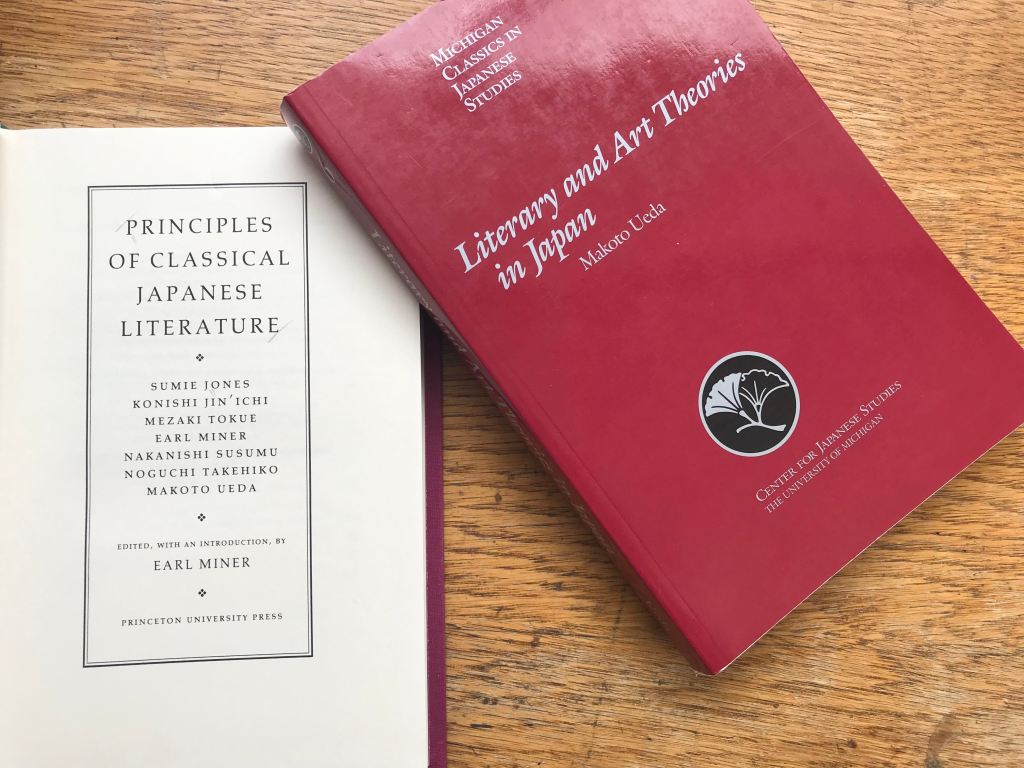
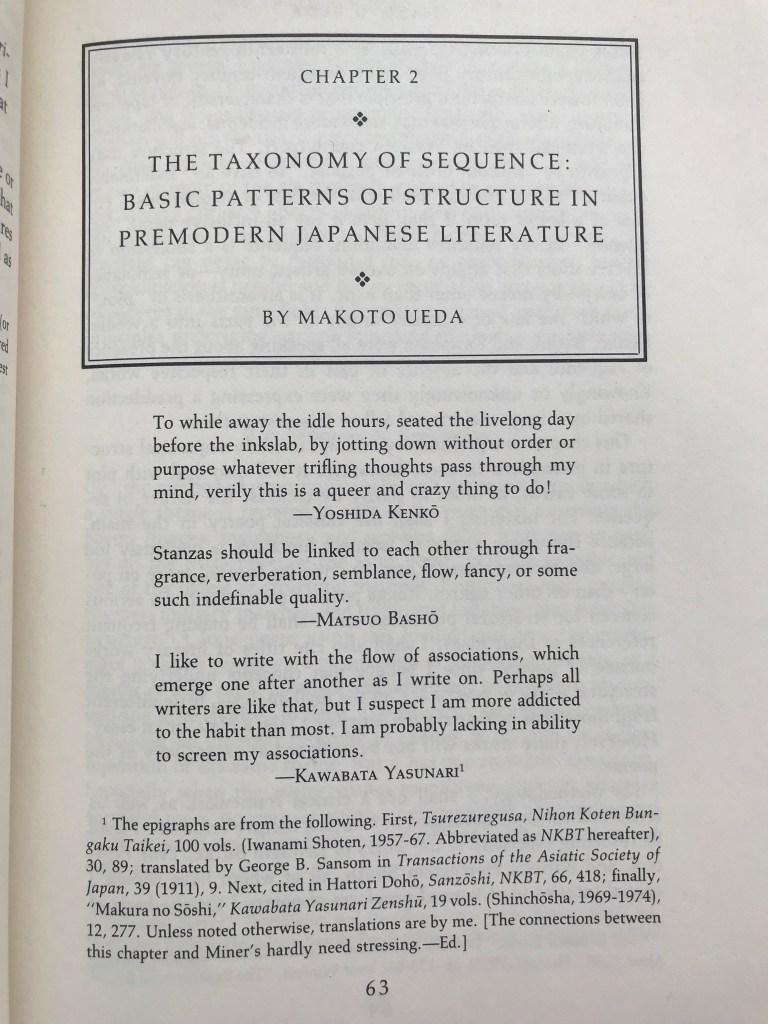
(adapted and selected from Makoto Ueda’s essay “Taxonomy of Sequence”, in Principles of Classical Japanese Literature, ed. Earl Minor, 1985, Princeton University Press; translations of poems by Earl Minor, Burton Watson, Makoto Ueda, and others.)
Taxonomy of Sequence, an overview:
Repetition: a single idea in a sequence of various images, metaphors, words.
Temporal Sequence: a sequence following the flow of time
Narrative Logic: a sequence following the arts of narrative
Logical Sequence: a sequence following the steps of making a logical argument
Double Mood: two contrasting attitudes placed beside each other
Personal Progression: a sequence following the impulses of a consciousness
“We might probe into the reasons why classical Japanese poets and writers were so fond of repetitive method, of temporal sequence , and especially of qualitative (or personal) progression.” (104)
Repetition
Blossoms have fallen
and in the branches nothing
is left of the wind
with an old cherry tree
spring has come to a close (tr. Ueda)
This is an example of shakushi, in which the second stanza repeats the first, explaining rather than showing. “No sense of freshness arises from the way in which [the second stanza] is linked to the preceding one. Such is the technique of a mediocre renga poet.” (Ijichi Tetsuo, ed., Rengaron Shinshu, Koten Bunko, 1956, pp. 140-141.) (70)
“Linking through four hands”, or yotsuezuke, is a technique of close linking that is easily confused with shakushi:
The boat speeds away
on the water of the Yodo River
in the middle of the night
isn’t there a more relaxing way
to travel? (tr. Ueda, slightly modified)
Two stanzas linked by yotsuezuke resemble sumo wrestlers in cross grips. The second stanza gives additional information that results in a progression of mood: adding night to the fast moving boat makes one think of an emergency of some sort; and the final two lines show a personal response, which makes a progression from the strict observation of the first stanza.
The technique of repetition can easily produce boredom. “The poet has to supply each stanza with a sense of novelty and variety,” says Ueda (71). “On the other hand, if [the poet] gives too much novelty and variety, the poem will lose simplicity, straightforwardness, and other strengths of [repetition].” (71)
Temporal Sequence
“Temporal sequence was not widely popular among Japanese poets. . . . In renga, the case of a stanza on an autumnal topic following a summer stanza is relatively rare because that would be too simple, too orderly, too artless. The interest in writing or reading renga lies precisely in being an autumn stanza following a spring stanza, a winter stanza, a love stanza—anything but a summer stanza.” (77)
Narrative Logic
“Renga poets sometimes made use of narrative method. They invariably refrained from following the storyline too far, however, because doing so would create rinna, an overlong succession of similar stanzas.” (83)
One type of narrative sequence, honzetsu, uses an allusion to a well known story or historical event:
This morning, a rare sight—
white snow on the ground!
to a village
known as Ono, a visitor
makes his way. (tr. Ueda)
“This looks like a fragment of a story. The snow has fallen during the night and piled up on the ground. The story’s hero is overjoyed to discover the rare sight in the morning. He wants to share the joy with his friend who, he knows, understands such poetic beauty; thereupon he pays a visit to to a remote village where the friend lives. Because the village is identified as Ono, the hero must be someone like Ariwara Narihira who, as the Ise Monogatari tells us, visited his close friend, Prince Koretaka, in the latter’s retreat in Ono one winter day.” (84)
Haikai, a later, less formal type of linked verse, used a similar method called omokage. The allusion made in omokage is more indirect and vague:
For a little while
I remain at my hermitage
and then am off again
happy in old age that my poems
have won place in a collection
(tr. Miner, Japanese Linked Poetry, 311)
The second verse may, or may not, refer to the wandering poet Saigyo.
Logical Sequence
Because the waka is such a short form, parts of the logical argument are left out, to be inferred by the reader:
If there were no such thing
as cherry blossoms
in this world,
in springtime how untroubled
our hearts would be!
Now when spring mists rise,
the wild geese
turn and fly away!
They must be used to living in villages
where no cherries bloom.
(These two translations were made by Burton Watson, in From the Country of Eight Islands, p. 108 and p.127)
“The logical method was never very popular among renga poets, but they did make use of it in the same manner as waka poets. It manifests itself most often in what is called kokorozuke or linking through meaning.”
Although a horse is available
he chooses to travel on foot
at daybreak
discovering the snow that has piled up
during the night. (tr. Ueda)
“The premise is omitted, but it must refer to the fact that anyone with a poetic mind enjoys a snow scene. Obviously the traveler in this verse is such a person; he would rather go on foot and leisurely enjoy a rare sight.”
The Double Mood
“The double mood refers to a structure in which two different, often contrasting tones are used in successive or alternating literary units. A poem with a lyrical mood may suddenly take a sarcastic turn in midcourse, or an elegant love story featuring a nobleman and a court lady may be interspersed with bawdy scenes involving people of the lower classes.”
May my lord’s reign
last for a thousand, ten thousand
generations hence
till the smallest pebbles become
soybeans covered with moss. (tr. Ueda)
“The tone of the first four lines is serious, even solemn; as a matter of fact, these lines are identical with those of an old poem which is now the national anthem of Japan:
May my lord’s reign
last for a thousand, ten thousand
generations hence
till the smallest pebbles become
boulders covered with moss. (tr. Ueda)
“But that somber mood is suddenly broken in the last line: in place of the rage of stately boulders greened with moss, there are small soybeans covered with moss-like seaweed! The surprise is great in the original Japanese, which keeps the suspense intact unto the very last syllable of the poem.” (92)
“A similar technique is often used in senryu, which, however, cannot build up suspense as much because of its shorter form”:
Zen priest
meditation finished,
looking for fleas.
(tr. Bownas and Thwaite in The Penguin Book of Japanese Verse, p. 131, slightly modified. (Ueda, 93))
Two more examples of double mood:
When large groups of plovers
continue to cry out in spring,
everything alive
finds itself renewed again.
I alone grow old. (tr. Ueda, slightly modified)
In the morning breeze,
letting the hair be blown—
a caterpillar. (Buson, tr. Ueda)
“Instead of a woman, there is a hairy caterpillar. The poem produces surprise, but the surprise leads . . . to a discovery of novel beauty.”
“The double mood appears frequently in renga, too. This is natural, because in renga two successive stanzas that make a unit are composed by two different poets. The first stanza was often given a very different interpretation by the composer of the second stanza.” (95)
Green or red, they are
terrifying ogres either way
under a pine tree
in the yard of a rooftile shop
leaves have begun to color. (tr. Ueda, slightly modified)
“The mood of the couplet is rough, crude, and even a bit grotesque, presenting ogres of all sizes and colors. The triplet that follows subdues that inelegant mood. . . . What looked like ogres were really gargoyles piled up by a rooftile shop, and they looked red and green when seen through tinted autumn leaves. The method of linking used here is clever, witty, and imaginative. The author of Renga Shotai Hiden Sho stressed that this kind of method had to be used when the previous stanza had a rough, inelegant mood. ‘If the second stanza should also go wild like the first,’ he said, ‘it will impair five, or even ten, stanzas that follow’.” (95)
“The double mood is observed in another conventional method of linking renga stanzas. This one is called ibutsu no tai, or form with an alien object”:
The moon likes a little hazy
in the evening twilight
on a hollow tree
where bears make their home,
blossoms are in bloom. (tr. Ueda)
“The couplet depicts an exquisitely beautiful scene of a spring evening, with a large moon hanging hazily in the sky. The triplet that follows, however, abruptly changes the tone by introducing ‘an alien object’, the terrifying image of bears. Yet the elegant mood is restored in the last line of the stanza, which refers to cherry blossoms blooming on an old tree. The elegant and inelegant moods coexist. . . .” (95-96)
Personal Progression (Qualitative Progression)
‘’Qualitative progression’, a term invented by Kenneth Burke (Counter-Statement, pp. 124-5), refers to a structural method in which the quality of personal mental experience is the central principle unifying different parts of a literary work. . . . One might call it ‘associative sequence’, as Barbara Herrnstein Smith did, since it integrates different parts of a literary work through the association of the author or a main character (Poetic Closure, pp. 139-150).”
“The genre that makes most frequent use of qualitative progression is renga, in which stanzas are linked largely by association. Many of its codified linking methods fall in this category. The simplest of these is called keiki, or linking through the mood of the scene:
Barely continuing onwards,
a old trail across the fields
amid a cluster
of slanting bamboo leaves,
plum blossoms in bloom. (tr. Ueda)
“The couplet describes a country scene. The author of the subsequent triplet caught the spirit of the scene, which was that of lonely beauty. Then, dipping himself deep into that lonely mood, he came up with a stanza that creates the same impression: plum blossoms blooming amid a bamboo bush. He did not say, but the blossoms are sparse, for the tree is wild and has to compete with the vigorous root system of the bamboos for its nourishment. The progression from the couplet to the triplet works subtly, using a mental quality that is the core of qualitative progression.” (99)
“The connection between two stanzas is more remote and personal in the method called uzumizuke, or linking through a hidden allusion. The method is somewhat akin to honetzu, except that in this instance allusion is less obvious and need not be to an old story. Indeed the allusion may be so vague that the reader may miss it; even so, no great damage will be done to the poem:
A boat rowing out to the sea
in the chilly coastal wind
far away a pine grove:
on the beach covered with snow
the day begins to dawn. (tr. Ueda)
“At first glance there two stanzas may look as if they were connected by keiki, since a beach scene follows the image of a boat. Fukui Kyozo, one of the modern authorities on renga, in fact has said that this is an instance of keiki. But the author of Renga Hiden Sho notes that the connection has been made through a waka by Priest Mansei:
To what shall I compare
this life?
the way a boat
rowed out from the morning harbor
leave no trace of the sea.
(tr. Ian Hideo Levy, The Ten Thousand Leaves, 1, 189)
“Upon reading the couplet, the poet next in turn was reminded of this poem by Mansei and came up with the image of snow-white waves pounding the beach. The allusion is vague: it is so well hidden that even the most knowledgeable reader may miss it. In an extreme case of uzumizuke, only the author of the verse may know the allusion, because the association is too personal.”
In another technique used in renga, the link between stanzas is obvious but nevertheless whimsical. Called kokobazuke or linking through diction, the technique is common in renga. Basically it is a play on words. The author of the second stanza picks out a word from the first stanza and builds his own stanza around its homonym or homophone. The two stanzas thus joined have no ostensible relation to each other except by coincidence in pronunciation”:
I tried to hate her, and that
consoled my heart a little
extending toward
a pine grove on the beach,
this traveler’s road. (tr. Ueda)
“The English translation does not make much sense. The subject of the couplet is love: a man rejected by a woman is trying to console himself by hating her. The triplet, on the other hand, is about a traveler who is enjoying scenic beauty. the connecting link is a Japanese word ‘urami’, which means at once ‘to hate’ and ‘to see a bay’. The author of the couplet intended the word to mean ‘to hate’, but the writer of the triplet took it for the other meaning. According the second author’s interpretation, the couplet would mean something like
I saw a bay, and that
consoled my heart a little.
Here is a traveler whose loneliness is mitigated a little by the beautiful sight of a coast. Kotobazuke, then, is quite a complex and subtle technique. On the surface the two stanzas are lined by a coincidence in pronunciation, yet underneath they create an interesting interplay of meaning. To put it simply, the stanzas just cited seem to imply: “Man has to face many hateful things in this life, but fortunately there is a consoling element in the very act of hating, just as a traveler who meets many sorrowful events along the road may come upon a beautiful scene of nature once in a while.” (101)
“There are many more methods of linking stanzas in renga that can be considered variations of qualitative progression. Yosei (linking through surplus meaning), sotai (linking through contrast), honka (linking by allusion to a well-known poem), nadokoro (linking by allusion to a famous place)—they all utilize associations for connecting stanzas. . . . The main pleasure of writing renga lies precisely in seeing the stanzas progress in an unpredictable way through the associations of different individuals participating in the writing.” (101)
“The methods of renga composition were taken over and refined further by haiku poets. The names by which the methods cane to be called were different, but by and large they were varieties of associational sequence. Nioi (fragrance), hibiki (reverberation), utsuri (reflection), and omekage (semblance) are all impressionistic terms that suggest ways in which the mood of one stanza is transmitted to that of the next. It is as if the fragrance of a flower were drifting in the air, or the sound coming from an object were causing some other object to reverberate with it.” (102)
Of the following pair of verses, Ueda says, “On the surface it is difficult to see what integrates the second stanza with the first. The couplet is a description of rice plants in summer, whereas the triplet presents a man who has recently had a religious awakening and who is leaving the capital for the remote eastern provinces. A closer examination reveals, however, that there is a common quality of mind implied in both stanzas. In the couplet, rice plants are not growing vigorously because of bad weather. There is something stagnant, feeble and indecisive in the picture described. That mood is reflected in the image of a man who, although having renounced the world, still finds himself attracted to the capital even as he passes through the Suzuka Pass.”
Rice plants in their growing season Ine no hanobi no
feeble in the feeble wind chikara naki kaze
starting a new life hosshin no
as a monk, he travels hajime ni koyuru
through the Suzuka Pass. Suzukayama.
Makoto Ueda (1931-2020)
Wisdom begins with death. And death begins with life.
For the young, death may seem a long way off. It is well-known that as the years gather, as we pass through the years of our lives, time passes more quickly. A summer in our youth, a summer break between one grade and another, seems to go on and on and on. But even five years, or a decade, can seem to speed by for an elder. These are common experiences, shared by many people.
In the world of mathematics, part of which is measurement, and measurements of time, any five years, for example, is equal to any other five years. Five winters, springs, summers, and falls, for those of us in parts of the world that have these seasons. Five rainy seasons, five times around the sun, five birthdays, five New Year’s days, five grades in school, one year for each finger on a hand. Five Decembers, five Junes, five Marches, fives Septembers. Five winter solstices and five summer solstices. Five spring equinoxes and five fall equinoxes. One year for each numeral: one, two, three, four, five. This is the world of counting, of sets of things, arithmetic, adding one, all part of the world of mathematics. Five years is five years. It is measurable and countable. You and I can agree. Five years.
But part of the world of wisdom, and mathematics, is in knowing what does NOT belong to the world of measurement and counting and math. That five years for a child is not the same experience as five years for an elder. Here, five does not equal five. In mathematics, five = five. Always. Part of wisdom is learning, and part of learning is knowing what you are not learning.
A person might like to think of mathematics as a tool. A camera is useful when taking photographs. But not as useful when putting paint on a canvas.
A person might like to think of mathematics as a way of seeing and experiencing the world. Seeing the world as in interconnected web of different forms of energy, some easy to notice and some more subtle, is useful when making large-scale decisions. But maybe not if you are trying to figure out how to get home in time for your daughter’s birthday dinner.
Erik Erikson, a mid-twentieth century psychologist who was one of the first people to think about adult stages of life, distinguished the opposition of basic trust and basic mistrust that, in his view, a person developed in the first year of life. If you wish to investigate his particular ideas, his book Identity and the Life Cycle is a place to start. But for mathematics, which includes various structures of opposites, and for wisdom, which includes notions of trust and mistrust, the idea that some people have a basic trust in the world and other people have a basic mistrust of the world, could be a meeting point for wisdom and mathematics, an aspect they both include, or a meaningful part of their overlapping features.
A person might like to think of mathematics a a kind of reasoning or thinking in which there is no uncertainty, in which every statement that is accepted, every conclusion that is proved, is built on other statements that are certain themselves. By building certainty on top of certainty, a structure is created in which uncertainty is eliminated.
It could be wise to wonder why such a desire for certainty exists: is it from a basic mistrust of the world, of life? Is it a descendant of an evolutionary need for knowledge about high-probability events needed for survival?
Carl Jung, a 20th century Swiss psychologist , described certain people as introverts and others as extroverts. His analysis is much more complex and interesting than the oversimplified meanings we commonly give those terms. In his book Psychological Types, Jung describes that introvert attitude as an “abstracting” attitude, an attitude that is intent on removing energy from the world around it, as though it had to prevent objects from gaining power over it.
The extroverted attitude, on the other hand, shows a very positive relation with the world outside: the importance of outside events and objects is granted without question, and the person showing an extroverted attitude has inner thoughts and feelings that are constantly yielding to the outward conditions. The introverted attitude, oppositely, give unquestioned importance to inner events.
Using this way of looking and understanding, we could choose to view the desire for certainty in mathematics as consistent with the orientation of an introverted attitude: that the creation of axiomatic systems, or structures of statements meeting a particular criteria for certainty, provide a safe arena for the introverted attitude. We may then distinguish two different types of mistrust: the mistrust of the introverted attitude, which mistrusts in some sense everything outside of its inwardness, and the mistrust of the extroverted attitude, which mistrusts only particular things outside of itself, based in general on external experience (along with a basic mistrust of all thoughts and feelings that appear to originate within).
It is possible to even reverse the meanings of inside and outside: for an extroverted attitude, the outside (what the introvert experiences as outside) is experienced as inside, and vice versa.
The complexity of the duality of introvert and extrovert, and their richness and ambiguity, can also emerge when we wonder if the positive experience of certainty communicated by mathematical structures might actually be an experience desired by extroverts since it gives a sense of control over inward thoughts, the location of fear for the extroverted attitude.
The desire for mathematical certainty may also arise from Erikson’s idea that every person has either an orientation of basic trust or mistrust. Or we might find a more fruitful explanation by questioning whether certain cultures are more orientated to trusting or to mistrusting, to introversion or extroversion.
The intersection of mathematics and wisdom is not empty. And to become an area of study deserving of all the time and energy that we require our children to put into it, we must make mathematics more wise than what we teach now.
The political and social world is a complex beast, or perhaps better, a complex of beasts.
On the other hand, Kenneth Burke. He died in 1993, at the age of 96. Although I have been aware of his name for many decades now, as well as the titles of a few of his books, including A Rhetoric of Motives, A Grammar of Motives, and Language as Symbolic Action, it wasn’t until I began a deep dive into James Jasinski’s Sourcebook on Rhetoric a few weeks ago that I began to have an appreciation for both the arenas of Burke’s thought as well as for the depth and earnestness of Burke’s thinking.
On the other hand, Kim and I took a lunchtime walk into the hills around the dog park near our house.
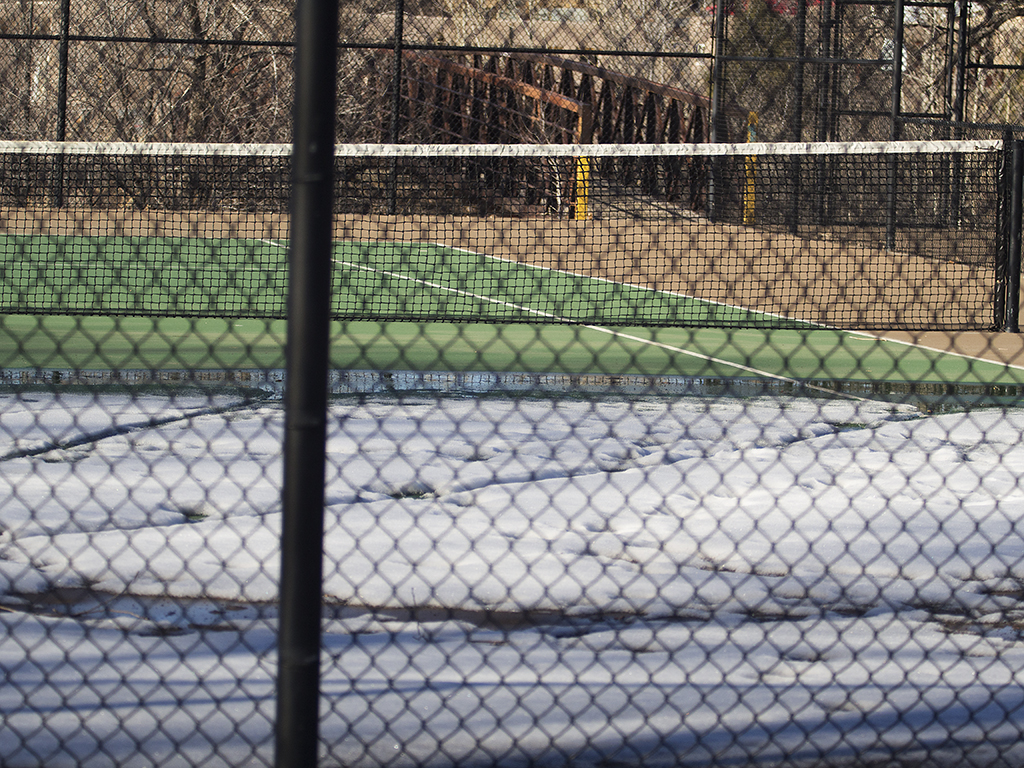
When we got back to the house, I opened a package from Powell’s bookstore in Chicago. It was The Selected Correspondence of Kenneth Burke and Malcolm Crowley, 1915-1985, edited by Paul Jay. The book was a used paperback in good shape that was printed in 1990. An hour later or so, I put the book in a small backpack, along with an old, small Olympus E-PM2 digital camera which was attached to an even older lens, my first lens, the only lens I owned when I was shooting film, a Canon FD 80-200 f/4L that I used in the late 1990s with my Canon F-1, which was my film camera that I loved in part because it was fully mechanical (except for the light meter, which was powered by a small battery). The 80-200 f/4 lens is not very large for a 35mm zoom, though it is a couple times bigger than the small camera itself, giving the combination an odd, long, narrow profile. Together, though, they make a fairly small and light setup. I headed on foot toward a nearby park with tennis courts and a large field with big cottonwood trees and some picnic tables near the trees, where I thought I would sit and read some of the letters between Kenneth Burke and his friend from high school, and throughout his life, Malcolm Cowley.
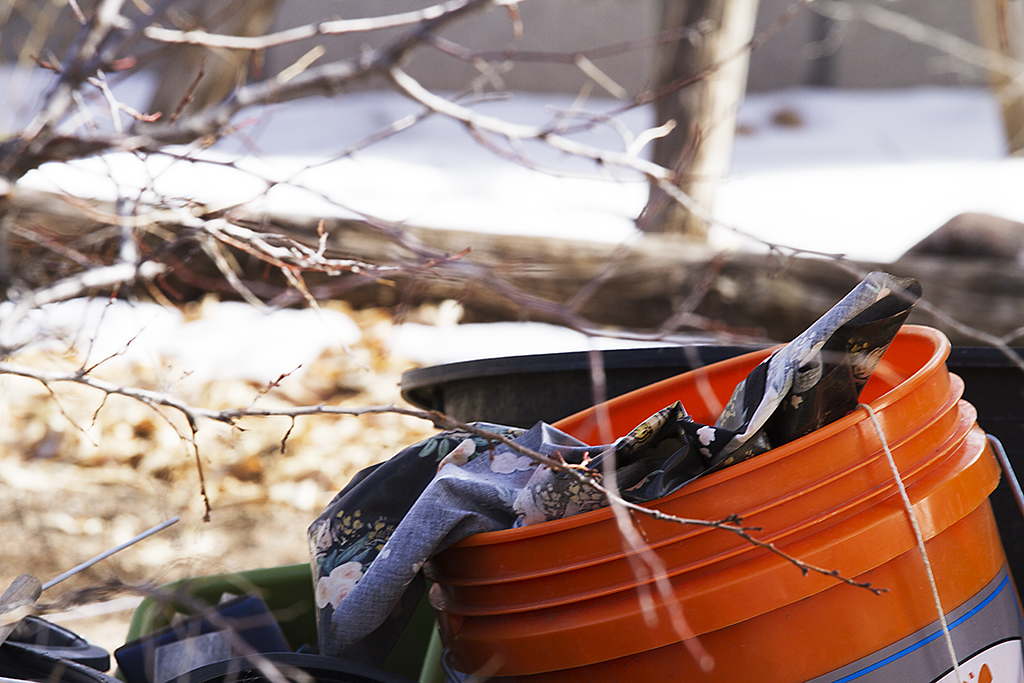
On the way to the park, I saw the straight lines of an iron bridge through a dense thicket of bare winter branches. Because the lens needs an adaptor to match the camera, I have to focus manually and adjust the shutter speed manually; the aperture is fixed at f/4. None of these are a problem. Similar to many other creative processes, constraints often end up being an advantage. I did my best to focus on the bridge beyond the branches. There is no eyepiece on this camera, and the display showing the potential photograph was hard for me to see. I found a composition and took a few images of it, turning the focus ring slightly between each image, hoping that one of the images would have the objects I was imagining in focus actually in focus. I found a few more compositions with the bridge and the branches and took a few images of each, hoping that one will be interesting when I look at them on a computer screen later on.
I sat at a picnic table in the sun. I opened the book of letters between Kenneth Burke and Malcolm Crowley. My interest in that book was to discover more about Kenneth Burke, to learn about him as a person, to complement what I had been reading about his thoughts and ways of thinking.
Burke wrote in a letter to Crowley in 1917, when Burke was twenty years old and searching for a path through life that seemed to fit him, “If I write what I think, I shall come much nearer to doing what I wanted to do than if I live what I think.” This struck me because, when I was in my twenties, I felt exactly the opposite.
So I saw Burke as a kind of inverse of myself, and I wondered if he, like I, partly changed his orientation as he got older. So I turned to the years when Burke was the age I am now, the years around 1957 when he turned sixty: “To disbelieve in success is no great burden; the real terror comes when one even disbelieves in failure, and that’s where I am.”
A few days ago I decided to start reading one of Burke’s books from the 1930s, Permanence and Change, because of how Jasinski had presented the relevance of Burke’s analysis and ideas for today’s world: ideas held by terms like scapegoating and mortification, recalcitrance and casuistic stretching, secular conversion and sermonic language, recalcitrance, mystification, and eulogistic covering. All these ideas bear on issues that feel vitally important at the present. Most are pertinent to avoiding the easy tendency to dismiss people with different ideas and orientations, an avoidance that is crucial for democracy to avoid falling into irreparable division, and a cold or hot civil war. My impression from Jay’s biographical contexts for the letters (which are an invaluable resource as they guide you gently through important events that aren’t necessarily mentioned in the letters themselves) and from the letters themselves, was that Burke was a complex person who, through a youthful desire for fame and glory found himself instead in a pursuit of depth and truth in the abstract ideas and concerns of his times, particularly ideas surrounding art, writing, and philosophical thinking. He struck me as someone who was never satisfied with where he was. When he finally did receive some measure of acclaim in his eighties, I’m not sure that it made him feel the way he had thought it would when he was young.
Which do we plant first, the external or the internal? We may not have a choice. But there’s a proverb that says “Don’t ignore the roots for the branches.” The world is a complex beast or a complex of beasts. I would suggest starting with what feels most important, and let life take you from there.
 Finally got back to work on this a few days ago. I’m working on the bottom: game positions from well-known games. Longshi (from games of blood and tears), Dosaku (from a Castle Game), Doteki (who died at 21 but defeated Dosaku in this even game), Jowa’s “Best Game of the Era,” Shusaku’s Ear-Reddening Game and his final game against his teacher, Shuwa, Shuei defeating Tamura (later known as Shusai), Go Seigen’s famous game against Shusai, and more to come. Even though the whole piece is fairly large (22″ x 30″), the board and stones are pretty intricate work. I’m using acrylic ink with a pen and nib for the stones and writing, and a tiny brush for the wash on the dark stones. Thanks for the patience while I am figuring out how to navigate the blog layout.

Thanks to so many people at the US Go Congress last week in San Diego, who were immensely supportive of my work and said so many kind words. This blog/gallery exists solely because of encouragement and suggestions I received to make my work available online.
This photo below is of a partly completed painting (22″ x 30″) that I began thinking about at the Congress, and started working on this week.
I hope everyone had a nice week in San Diego, and had safe travels home.


 Oblique Connection