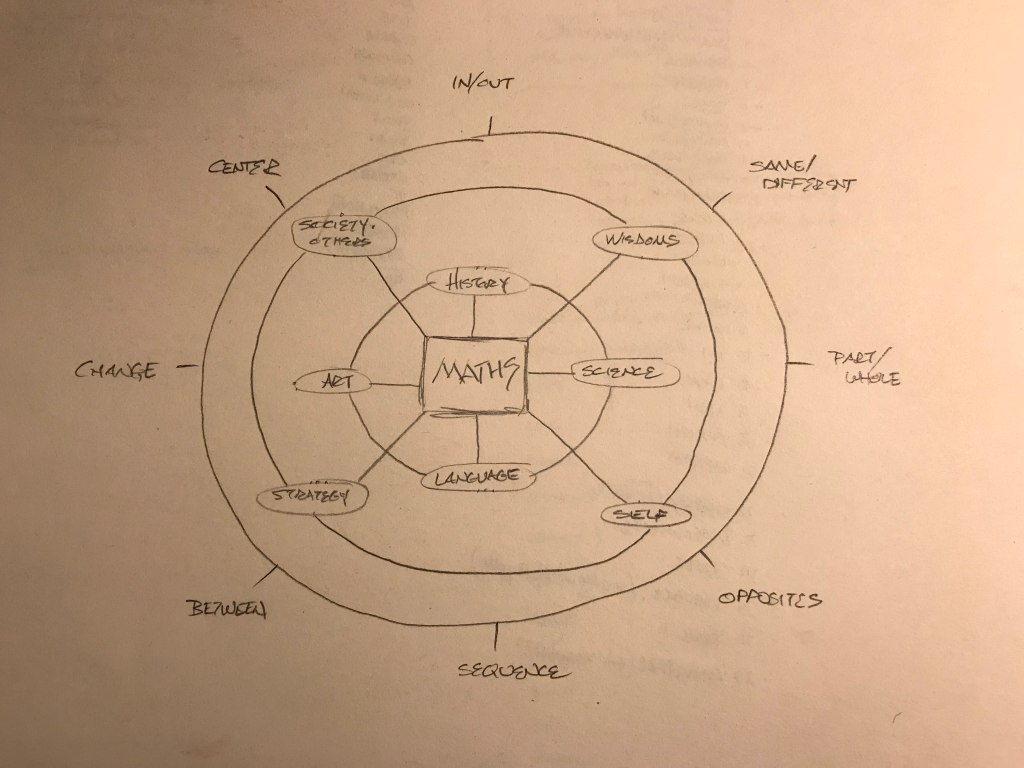
contents
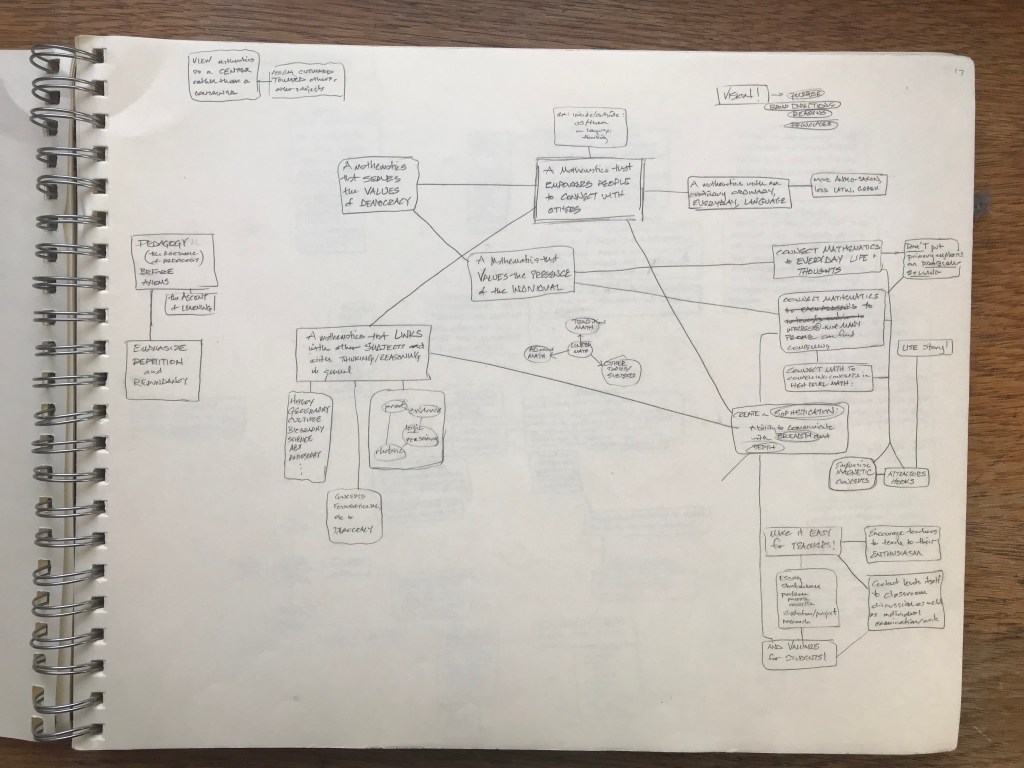
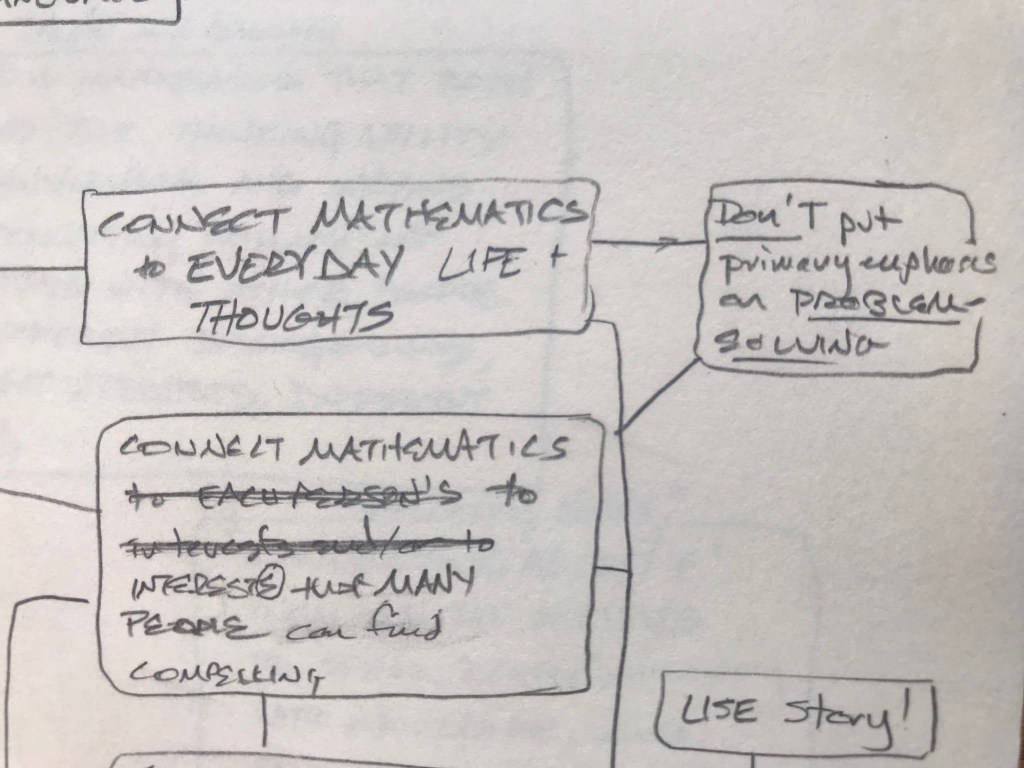
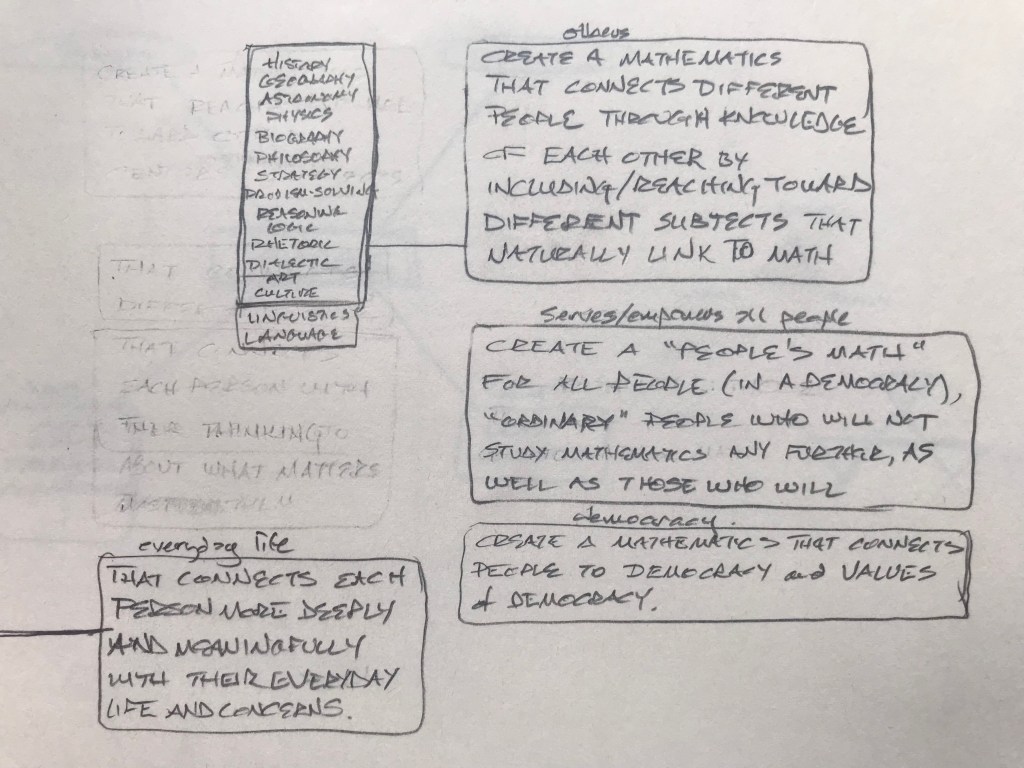
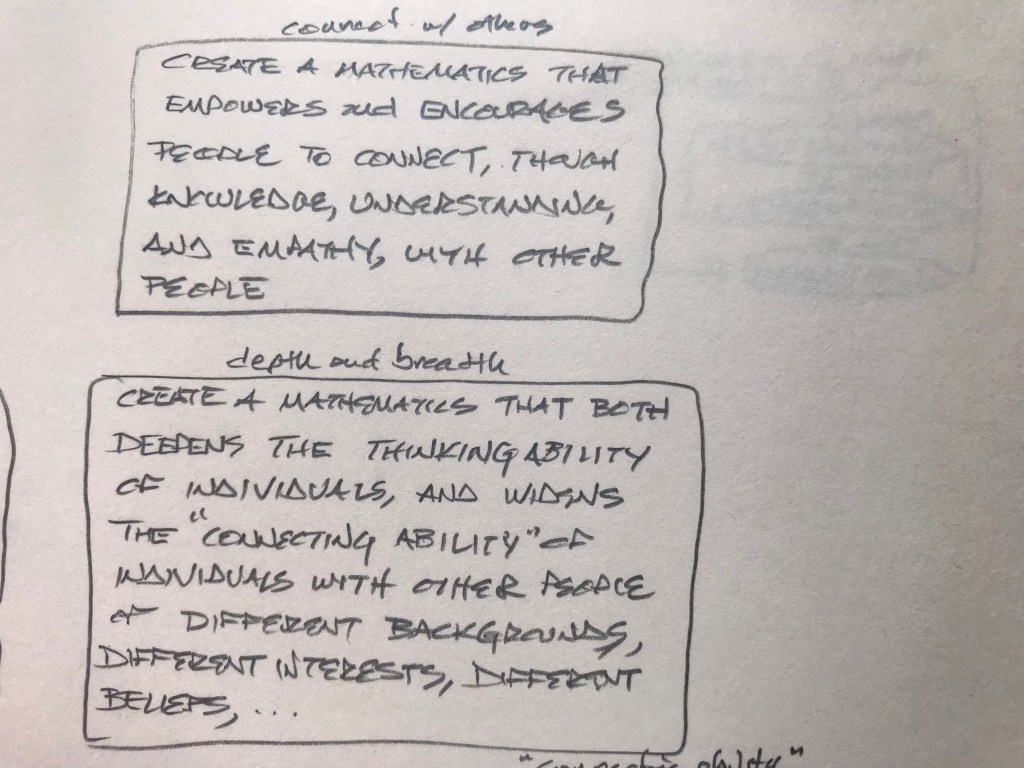
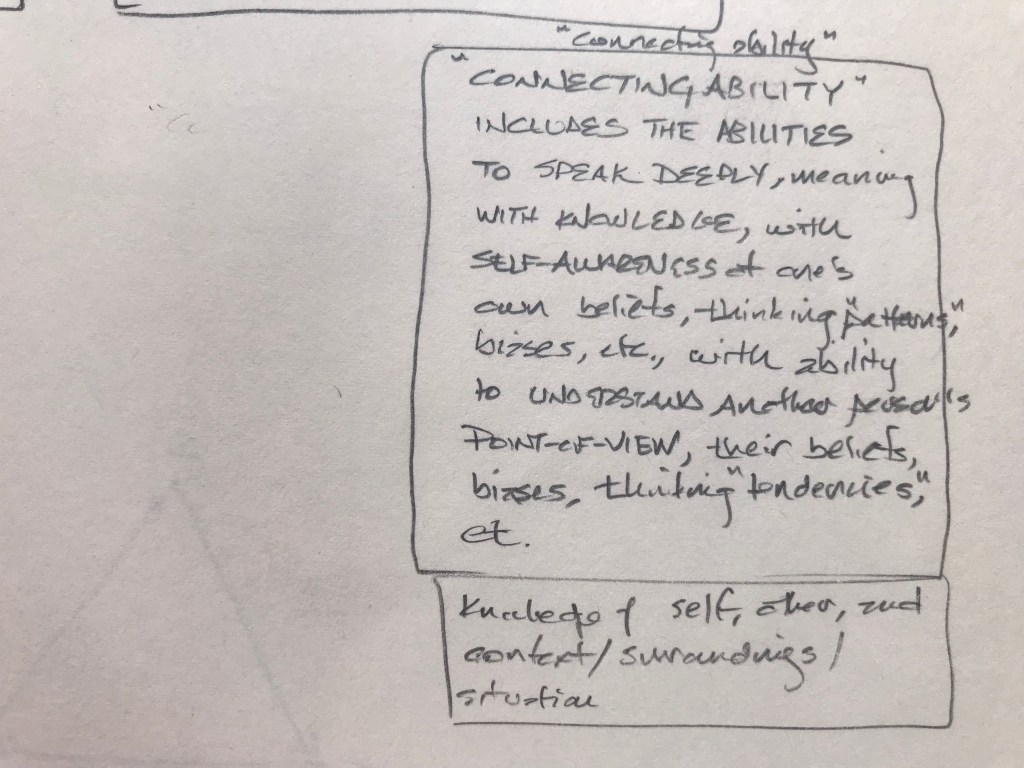
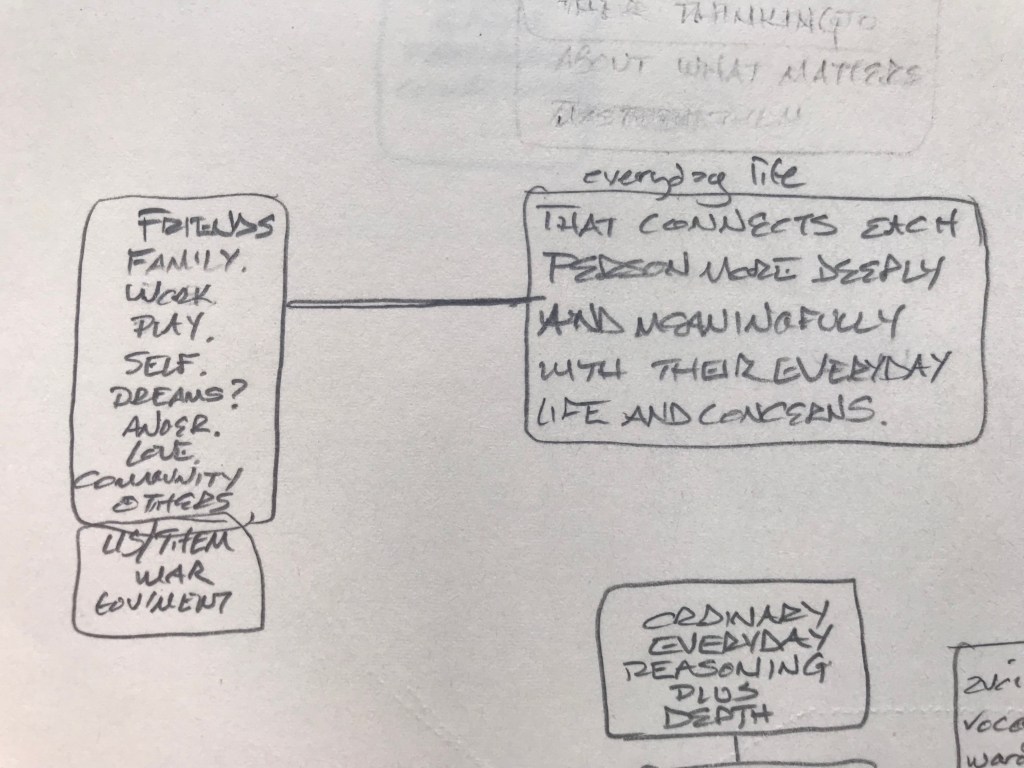
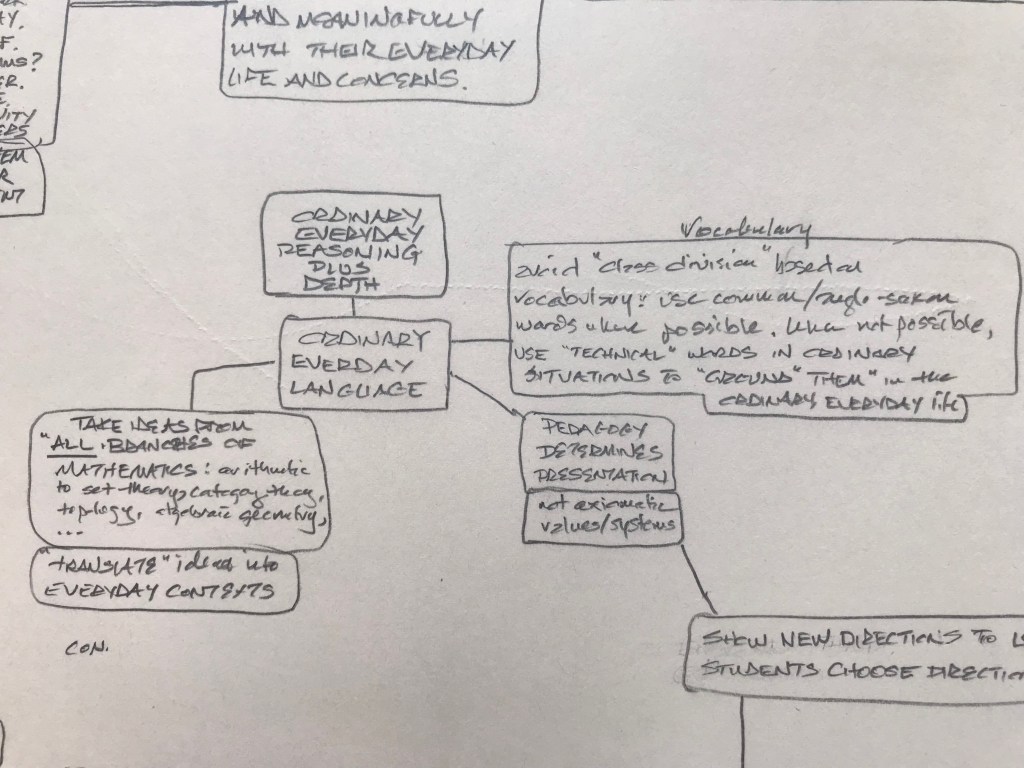
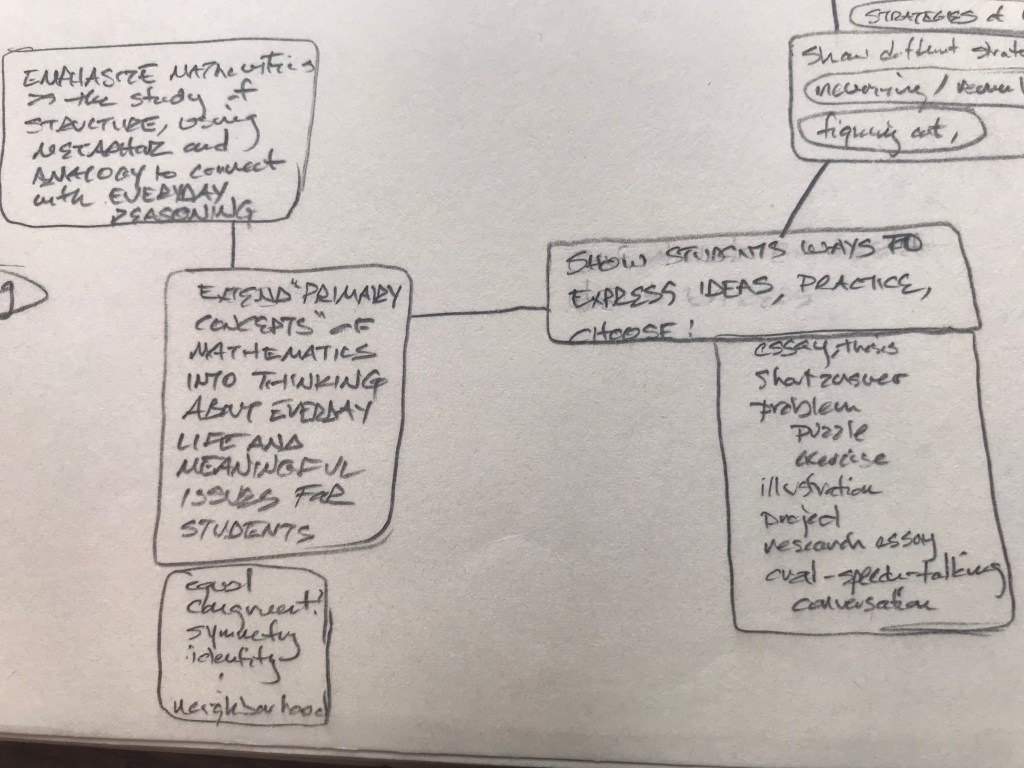
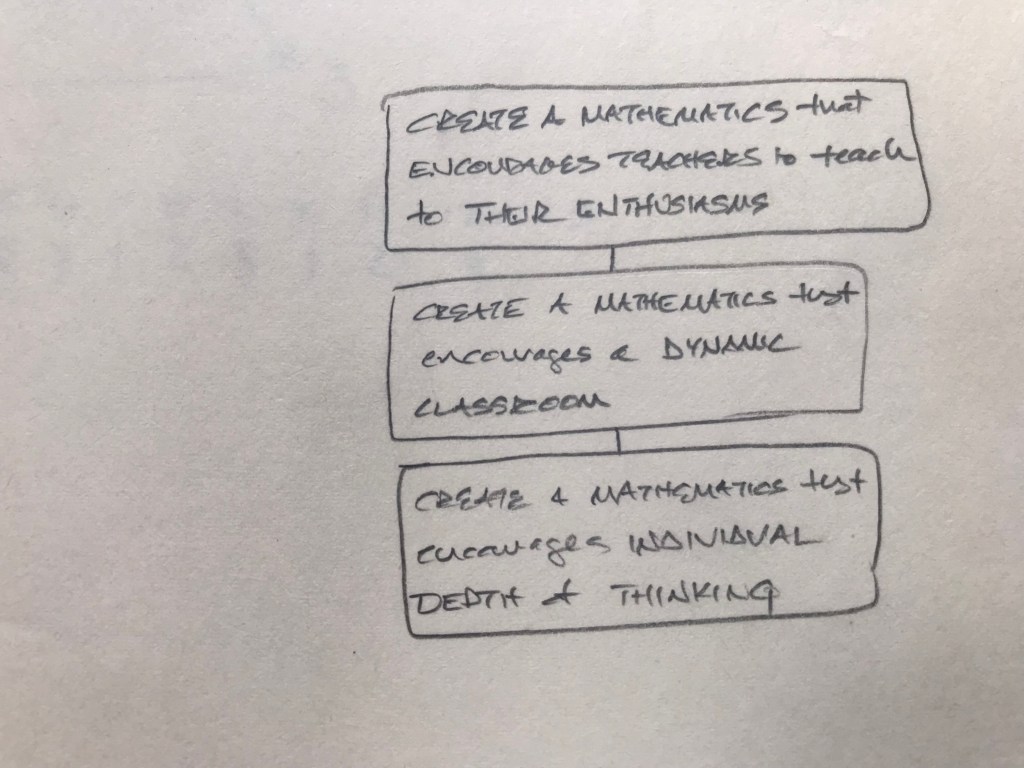
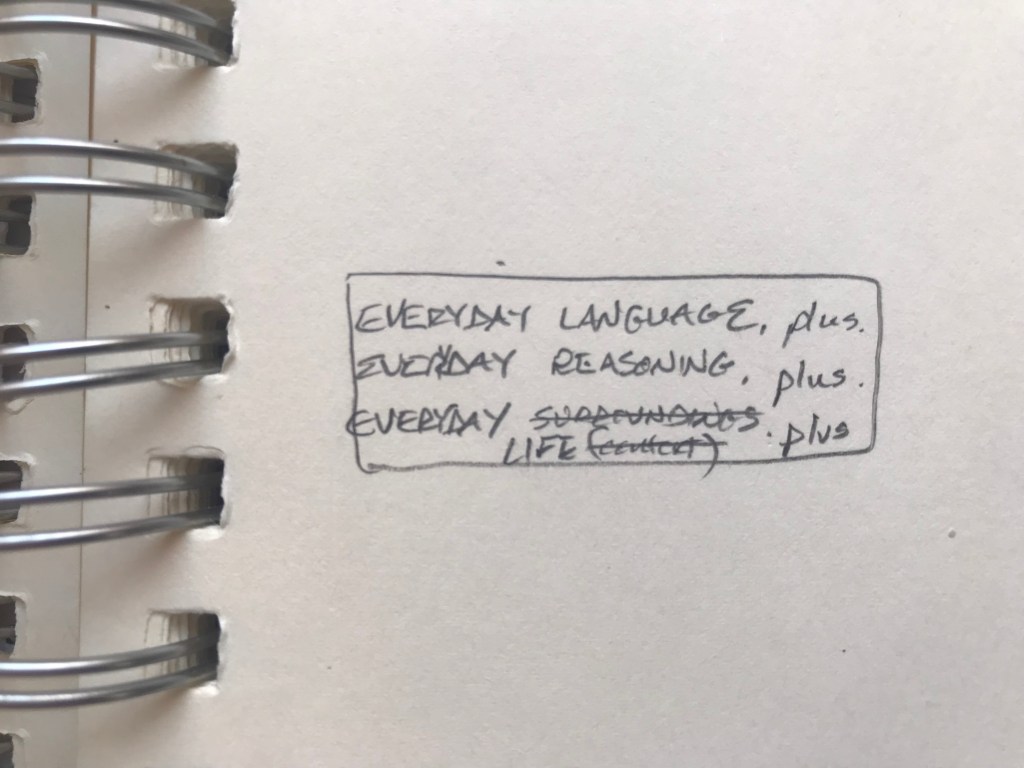
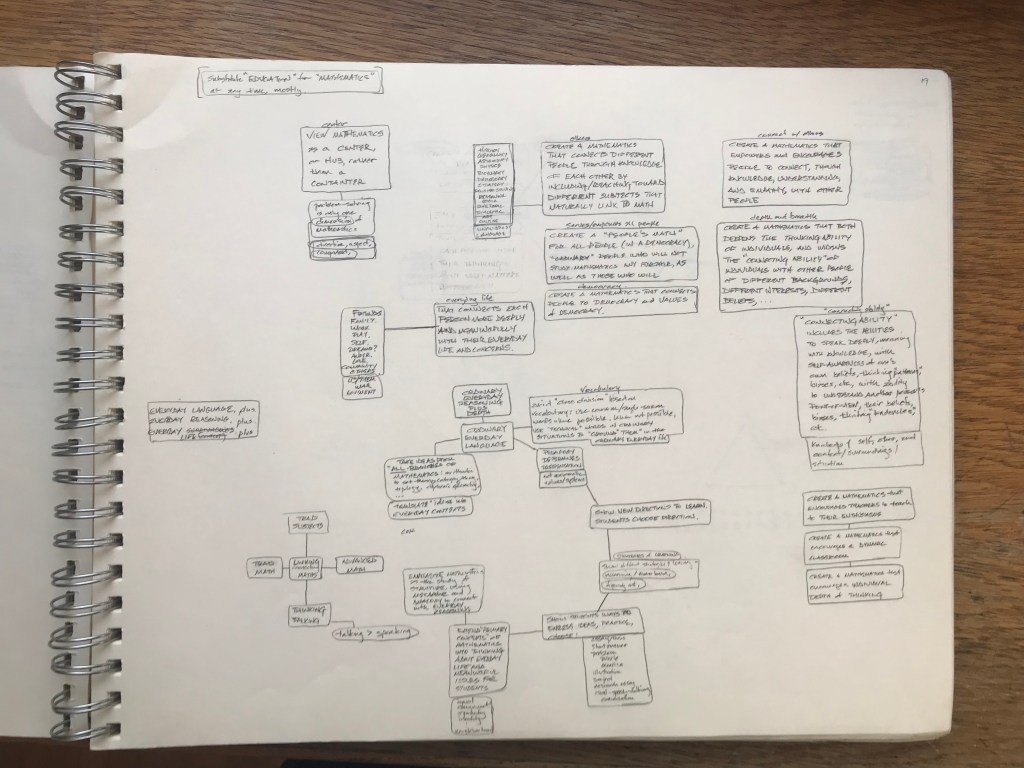
1 what matters/math (intro to the book/values)
2 me (intro to the writer–link: introduction–personal)
3 Fernand Braudel’s Mediterranean (concept: boundary–link:me– ideas)
4 Christopher Alexander The Order of Nature (boundary)
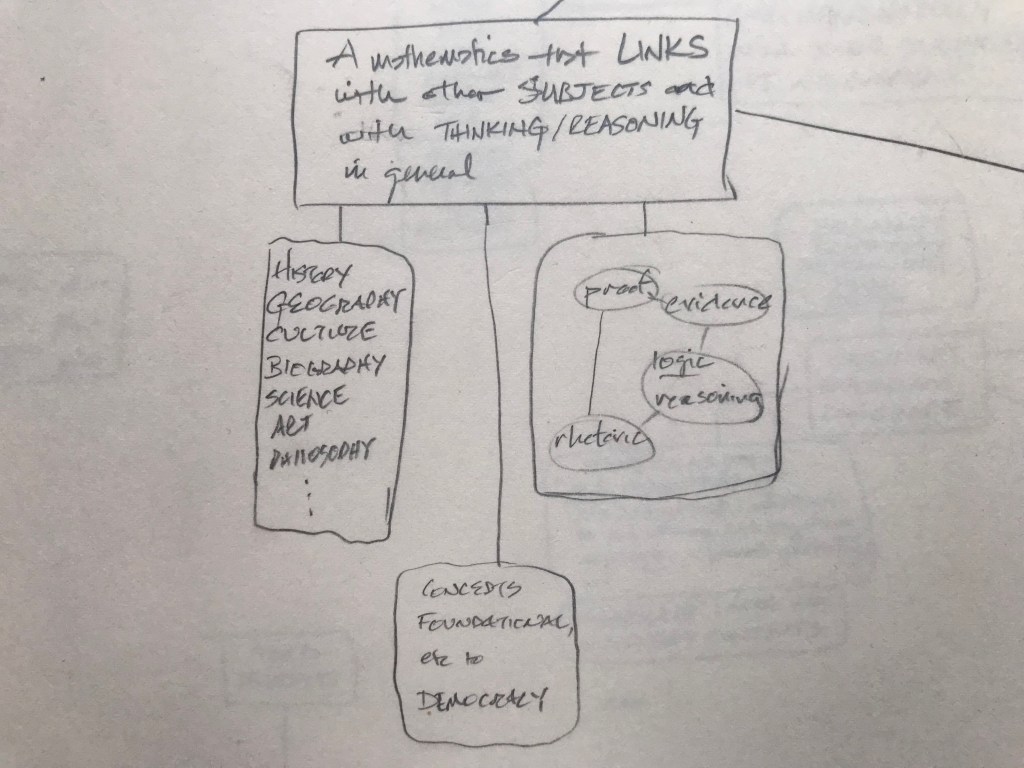
5 boundaries of math (boundary, math–link: concept –values/ideas)
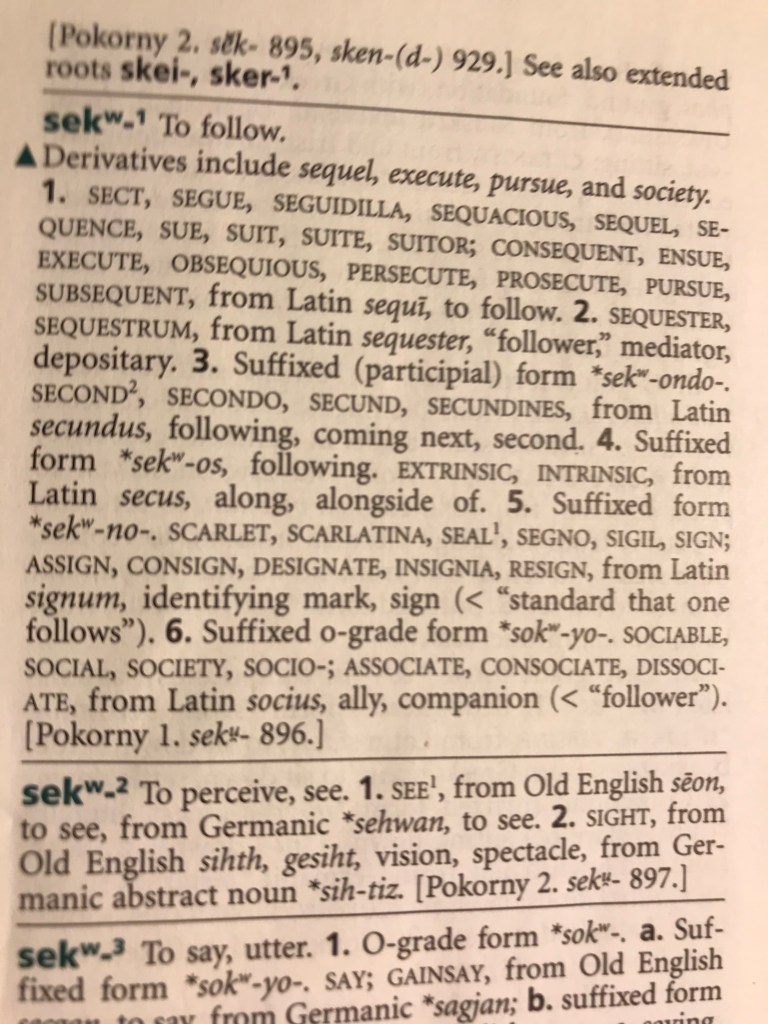
6 mathematics etymology (math example–link: concept–concrete ideas)
7 map/raven (map, concept– link: category to essence–personal/ideas)
8 Kokinshu preface/translation (map, example–link: concept to concrete–ideas/values
9 who can say how a few words here and there might help?
1
Friendship. Family. The sacred. Whatever each of us finds. Generosity. Humility. Caring for something beyond us. Wonder. Awe. The fragile amazement of being alive. What does mathematics have to do with any of this? Less than. Equal to. Greater than. Less than it needs to. Millenia of European math woven with Christianity, Islam, war; science, puddles of sewage, stores of grain; peasant rebellions, ocean navigations, mapping the globe; Europe, Rome, Greece; Babylonia, India, Egypt: Euclid, Alexandria, Alexander, the library; the Mediterranean, the Nile, Cleopatra; Caesar, Cicero: “x about friendship”; Marcus Aurelius: “x about y”; Quintilian argues that to be a rhetorician, one must be a good person.
2
It’s 2020, February, and I’m 58 years old. 59 in December. Seems like I’ll be 60 before I finish this sentence. The years and days, those “travelers of eternity”, the seasons, the summers, the snow, melting, another spring, another autumn, fall, fast and full, late winter now. Biking in Alaska, around the Olympic Peninsula, down the west coast. Pick-up basketball in afternoons with friends in college. Racing alone as a kid through the woods (with a red plastic stopwatch in my hand, three buttons sticking out on top, pushing the big green one in the middle Go!, bending around trees and branches, dodging, winding left and right till at last the trail comes out on the long gravel driveway, and I turn right and run straight, until the curve, the corner, and up the hill, the final stretch, pushing pushing across the concrete, and up the trail to where I started, press the red button, how many seconds and how many more? Did I go faster? Was I faster? I see where the second hand landed, catch my breath, and get ready to go again, trying for faster and faster, again and again.) Backpacking alone in winter down the Outer Banks of NC and along the gulf coast of Florida. Walking from Albuquerque to Santa Fe, and Santa Fe to Taos, letting go of story after story, walking, walking, writing haiku. Five years in a cabin with no running water, no electricity, not a single sound of traffic, walking into town, riding the bus to the community college to tutor math, walking home, at night sometimes with eyes closed to see how far I could walk, sitting on the porch playing clarinet into the mountains, one wonderful day, hour after hour, morning to dinner, without a break. Cabin surrounded by piñon pine and juniper, occasional lodgepole pine, studying game after game of the 20th century Go Master named Go Seigen. Sun setting early the mountain behind me. A book art class at the community college. Forty-nine poems, tanka, about death. Kim. 156 paintings of Shalesepeare’s sonnets: abstract calligraphies for each in a show with Kim. Our dog Kholi. Hiking with Kim for a month in Scotland. Just-born Rowan, not one second old, squirting through the water like a torpedo, picked from the water and handed to Kim, eyes wide open full of wonder staring up into her mother’s face. The midwife’s blue pool in our bedroom, holding Kim under arms, I held her up, I held them up. Twenty-three years now in Santa Fe, NM. Twenty-one years since I was first given Kim’s phone number by a mutual friend. Seventeen years since we got married. Seven years since Rowan was born. Six years in this house. It’s 1:59 am. Four and a half hours until I need to wake up. Eyes heavy for sleep, and I, sitting on the bed typing, a light beside me. Books on the bed nearby: Earl Miner’s Japanese Linked Poetry and James Munkres’ Topology.
3
The Mediterranean, a history, Fernand Braudel, two light red volumes, no dust jackets, on a shelf across the room. Braudel’s history doesn’t begin where you might expect, but with a great abyss of geologic time before humans, followed by millennia of unwritten humanity, and then, small dense centuries marked by human writing. And Braudel’s boundary of the Mediterranean Sea may not begin where you’d expect: not at water’s edge, but north into the nearby mountains of southern Europe, south to the great north African desert. Look beyond the water’s edge to understand the water deeply. Look before humanity to understand the written records deeply. The long history of the mountains and the desert, even how the water came to be the sea, the millennia of lives who lived there before writing, the people, the towns, the food, the daily lives, the everyday life. Sleep, travel, food; sleep, sunrise, food; rain, roof, boat; trade, water, food; sleep, shelter, peanut butter and jelly sandwiches, cans of baked beans, corn, tuna fish. The can opener edge of a pocket knife, a gift from my sister, making its way around the top of the metal can as I sit on a cement slab somewhere in California. Braudel shifted the boundary of history, of what should be given attention.
“No simple biography, beginning with date of birth can be written of the [Mediterranean Sea]; no simple narrative of how things happened would be appropriate to its history. . . . The Mediterranean is not even a single sea, it is a complex of seas; and these seas are broken up by islands, interrupted by peninsulas, ringed by intricate coastlines. Its life is linked to the land, its poetry more than half-rural, its sailors may turn peasant with the seasons; it is the sea of vineyards and olive trees just as much as the sea of the long-oared galleys and the round ships of merchants . . . ” (17)
Fernand Braudel was born in France, in 1902, had the best year of his life in Brazil, yet loved France enough to write three volumes on the identity of France. After the devastation and destruction of France and Europe during the first half of the 20th century, Braudel searched for a French identity in patterns of long duration, patterns that endured over hundreds of years of wars, over changes in power and revolution, patterns of identity that endured through the cultural and personal losses, pain, and tragedies that he had lived through in the 20th century, like a person looking for who they are, who they were, who they once were, to reconnect with that former, better self, and get sustenance from the past in the present, from who they were before those tragedies that overwhelmed their life and feelings, the tragedies that seemed to unmoor them from anything worthwhile, that left them floating without hope in a meaningless life, that left them only a dim memory of their best self, or when they were truly happy, or when, at least, each moment was not filled with the loss of family and friends, hope and belief, replaced by things like the guilt and pain of survival, if that.
(notes: “It might be thought that the connection between history and geographical space would be better illustrated by a more straightforward example than the Mediterranean, particularly since in the sixteenth century the sea was such a vast expanse in relation to man. Its character is complex, awkward, and unique. It cannot be contained within our measurements and classifications. No simple biography, beginning with date of birth can be written of the sea; no simple narrative of how things happened would be appropriate to its history.” (17)
“The Mediterranean is not even a single sea, it is a complex of seas; and these seas are broken up by islands, interrupted by peninsulas, ringed by intricate coastlines. Its life is linked to the land, its poetry more than half-rural, its sailors may turn peasant with the seasons; it is the sea of vineyards and olive trees just as much as the sea of the long-oared galleys and the round ships of merchants . . .” (17)
“To draw a boundary around anything is to define, analyze, and reconstruct it, in this case select, indeed adopt, a philosophy of history.” (18)
4
Christopher Alexander was born in Austria in 1936 and his parents fled with him soon after, in 1938, to England. He moved to the United States in 1958 to study at Harvard, and then at MIT, and then to teach at Berkeley, California, where he taught for almost 40 years. Alexander wrote profusely about architecture and design:
“About twenty years ago, I began to notice that objects and buildings which have life all have certain identifiable structural characteristics. The same geometric features keep showing up in them, again and again. Initially I began writing these characteristics down informally, and I began to ‘keep watch’ on them.”
Alexander came up with fifteen different characteristics that often occurred in “living” objects or buildings. One of these vital characteristics was strong boundaries:
“Early in my studies I noticed that living centers are often—nearly always—formed and strengthened by boundaries. . . . The purpose of a boundary which surrounds a center is twofold. First, it focuses attention on the center and thus helps to produce the center. . . . Second, it unites the center which is being bounded with the world beyond the boundary. For this to happen, the boundary must at the same time be distinct from the center being bounded (? Punctuation or missing word?) must keep this center distinct and separate from the world beyond it, and yet also have the capacity of uniting that center with the world beyond the boundary.Then the boundary both unites and separates. In both ways, the center that is bounded become more intense.”
“Boundaries do the complex work of surrounding, enclosing, separating, and connecting in various geometric ways, but one vital feature is necessary in order to make the boundary work in any of these ways: the boundary needs to be of the same order of magnitude as the center which is being bounded. If the boundary is very much smaller than the thing being bounded must can’t do much to hold in or form the center. A two-inch border cannot hold a three-foot field. In a room, the boundary between floor and wall needs more than a six inch molding—a wainscoting, 30 inches high, is more in scale with both. An effective boundary for the river Seine consists of roads, walls, paths, quays, trees, something almost as massive as the river itself. In general it is necessary to think of boundaries as very large.”
Visual boundaries, conceptual boundaries: boundary, the etymology and history of the word.
5
The boundaries of mathematics have been drawn with a cold and narrow pen. Life left out. Numbers, but not breath. Variables but not breathing. Manifolds but not friendship. Continuity, limits, infinities, but not love, death, and the infinite. Problems, solutions. Uncertainty, proof. But not people. Not wisdom. Not fear. Not compassion. Analysis and synthesis, but not self or society. Not a connection with something sacred, but a world of indifference, an indifferent distance from wonder, a different distance from one under others, humility, et cetera. A different stance that lacks compassion, a bond with apathy and not caring. Not caring, it brings not-caring into the world. Not knowing, it brings not-knowing into the world. Not connecting, not bonding, not loving, not wise, the best of each of us left out, a presence born from a process cut. Yet. We live surrounded by the sharp edge of math. Even simple signs beside the highway innocuously, helpfully even, giving the distance to the next city, shape how we feel and know our world, our movement, our stories, our ignorance, what we ignore, and know we are ignoring not. Professor West, Blacksburg Virginia, circa 1981, walks in late the first day of class, his tall body filling the door frame the first day of class, slamming the overhead fluorescent light switches down, voice deep, gruff, raspy, commanding: “We don’t use these in here. You forget that they buzz.” The buzz of numbers, unnoticed, without noticing, not even a second thought, not a second of thought, literally, not one second, less than a second, a lifetime unnoticed. This numbers, this math, this tiny slice of math, infinitely narrow, taut, tight, like a string twisted mightily around us, leading and then led by an occasional thought that everything can be measured, one, two, and/or three, should be numbered, accounted for, five, six, a graveyard for the unmeasured, seven unwalked trails of thought and perception, eight wisdoms lost, or more, nine, or ten.
6
The word “mathematics” came into English from the French, perhaps with the French-speaking Norman’s conquering and occupation of the British Isles beginning in 1066 CE and continuing until x. It entered the French language from Latin, or, more correctly, after the fall of the Roman Empire around 456 CE, and perhaps before that, the Latin spoken in the area now known as France changed into its own language, with its roots still in Latin, but its truck and branches becoming French through its reduced connection with the Latin spoken in surrounding areas, or for other reasons. The word “mathematics” entered the Latin of Rome from Greek, where it was spelled “μαθηματικός”, mathēmatikós. In Greece between 400 BCE and 200CE, when the word perhaps came into Latin, the word meant “fond of learning”, mathēmatikós, from μάθημα, meaning knowledge or study or learning. . . (from Wikipedia).
μάθημα, mathema, came to be a word spoken by people in the area that was later called Greece, according to the best reconstruction available in early 21st century, by a group of people speaking a language called Proto-Indo European, PIE. Conquering virtually all of Europe, beginning somewhere around x, they brought their language, along with beliefs and stories, and spread them throughout Europe between years x and y, according to the most recent theory that notices currently available linguistic, genetic, and archeological evidence. The reconstruction of this Proto-Indo European language shows the root mendh, meaning “to learn”, as the word that eventually was responsible for the Greek word μάθημα.
In English we can notice remnants of the earlier Greek meaning in the word “polymath”, a person who has knowledge in a lot of different areas. In addition, “men” is a PIE root meaning “think”.
Specifically in English, the word “mathematics” comes from From Old French mathematique, from Latin mathēmatica (“mathematics”), from Greek μαθηματικός (mathēmatikós, “fond of learning”), from Greek μάθημα (máthēma, “knowledge, study, learning”).
7
Winter turns to spring, and youth to middle age. An enemy may become a friend. The unknown may become known. Winter turns into Spring. Despair into Hope. Habits of Quitting to Habits of Persevering, of sticking it out. Curiosity into Knowledge. A clear winter day, windy, so I zipped my coat high as I walked back to the house a little after 5 this afternoon. Sun just above the horizon in my eyes whenever I walk west. Tomorrow, colder. Then warming, perhaps. Maybe 50 degrees, Fahrenheit, by the weekend. It is said. One thing changes into another. Between one and another, an arrow. A bare tree shows its first buds. Roots have sprouted beneath the surface, due to great diligence and concentration. But nothing has appeared above the ground. Patience. Keep focused on the roots. Do not feel frustrated at all. Continue to nurture that which leads to growth, and growth will have no choice but to follow. The I Ching, the third idea, the third change, Difficulty at the Beginning, it has been called, in English. The Book of Changes, it has been called in English, describes 64 kinds of change, though in that translation, “change” is merely an English word that found itself isolated, alone, surrounded by a culture and history it was not born in, did not grow up in. There is something we call a book, with its own word “book”, with its own history, its own etymology, its own character in the plot of European history, and whatever the I Ching is, or was, it is not that. And yet, the arrow of understanding, of interpretation, of hermeneutics, brings the I Ching into the word “book”, and into the word ”change”. By the arrow or mapping of translation, the I is brought into that European-derived history, etymology, into the character of the word “change”, which was born in Europe and was changed by the centuries, with its own associations, stories, printing press, bible, religion, free press, publishers, capitalism, democracy, Common Sense by Thomas Paine, popular fiction, non-fiction, public education in the United States, textbooks, learning, propaganda, communication, rhetoric, Aristotle, Cicero, Quintilian, law, laws, Constitution, Magna Carta, James Joyce, censorship, free speech, democracy again, type, font, the printing press, Winnie the Pooh, the Wizard of Oz, Alice in Wonderland, the Oxford English Dictionary, the American Heritage Dictionary, Samuel Johnson’s Dictionary of the English Language written between 1746 and 1755, the Chinese dictionary Erya, written in the 3rd century BCE, the Sumerian-Akkadian wordlists discovered in the country today known as Syria, but in the time it was written, around 2300 BCE, a place we call the Akkadian Empire and a country named Ebla, the internet, Wikipedia, Encyclopedia Britannica, search engines, Google, hardcover, paperback, dust jacket, binding, Aristotle’s works translated into Latin in pre-Renaissance Italy, Plato’s dialogues, Euclid’s Elements, handwritten, copied, Aquinas, Christianity, dogma, inquisitions, Martin Luther, reformation, Protestant and Catholic, words, wars, words, wars, disinformation, propaganda, freedom of speech, 1984.
And what of the history of the I Ching? What can we say? Working backward, perhaps we begin with the Tang Dynasty poets Li Bai, Du Fu, and Wang Wei. Perhaps the Tao Te Ching. Perhaps the commentaries historically attributed to Confucious concerning the 64 hexagrams of the I Ching, and then back to 2000 or 3000 BCE, some ancient time, tortoise shells, bamboo strips, the original I Ching text, to predict the future, to tell what will come, to know how to act therefore in the present. Change is alive between what was and what will be, what is and what was, and between what will be and what is. Change connects the past with the future, the present with the past, and the future with the present. Regardless of what came first and what followed, change is between them. In mathematics this “place” of between can be called an arrow. Or it can be called a map. Or a mapping. Or a function.
A raven landed on a fence post beside the road as we drove past. The night before I dreamed of a place full of gunfire and destruction, and then riding in the back of my childhood car, a Volkswagen bus, and my mother, who died a few years ago, driving me away from that to the country house I grew up in, and then I made a joke, a joke we had shared many times over the years, and I heard my mother laugh. A wonderful laugh. A wonderful sound. And then I woke. My seven year old daughter sketched my friend’s face before he returned to Warsaw, a city I had visited as an ignorant teenager forty years ago. He brought the sketch with him. The raven and the post. The dream and my mother. Santa Fe, NM, and Warsaw, Poland. Connections. Links. Relationships. Arrows. An arrow, a map. A mapping, a function. . . . . here I am.
A raven landed on a fence post beside the road as we passed. The dream of my mother driving me back to my childhood home from a place full of gunfire and destruction and then our shared joke that made her laugh just before I woke. I heard my mother laugh just before I woke. The sketch of my friend’s face that my daughter quickly made, and Warsaw, Poland, the city he returned to, a city I visited as a teenager, ignorant, forty years ago. The raven and the post. The dream and my mother, who died a few years ago. Santa Fe, NM, and Warsaw, Poland. Connections. Links. Relationships. Raven to Post. Dream to Mother, Mother to Dream. Santa Fe to Poland. The path of leaving and return for my friend. The connections. The between. The link, the relationship, the bond—whatever it is, it is neither one, but something outside each of them, something even between the words. An arrow perhaps, one that goes, perhaps, two ways. A mapping that could begin on either side. A map. A function. These words are words that mathematicians need to use when ordinary precision is not precise enough. The actual names are unimportant. Because we can make stories, true stories or false, about a horrible rich person becoming happy, or a horrible poor person becoming kind, or one thing turning into another, or one thing and/or two, we can watch change itself be named, have names. And the names for certain way of thinking about change are words like map, link, connection; mapping, function. This is a beginning of mathematics.
But to travel a little deeper, once we have the idea of arrow, say, or link, they become their own lives. And the stories we used to feel them into existence, to render them out of obscurity, or to rescue them from the void, are left behind, not only unnecessarily but potentially misleadingly. A change from one thing to another is a story, and a connection between two things that exist at the same time is a story, that is, a way of seeing, a site of talking, a tale of singing. But a pure mathematician will say the stories are merely the raft that helped us cross the river, the way a pure Buddhist might say this body, this life, this consciousness, is a vehicle for enlightenment, a vehicle to carry a person to the other shore. And once the word has been made, and its shorthand notation agreed upon, it leaves those stories behind, and exists outside that particular world of narrative, even outside any narrative or understanding we have of the world. It is function, precisely defined. Map, precisely defined. Arrow, precisely defined. An applied mathematician would, generally or often, find most interesting and compelling the stories that link the mathematical world to the world world. The pure mathematician lives in a world made of math houses, sturdy through seemingly transparent axiomatic bricks, and not blown down by winds of reason. But this idea that certain worlds can exist beyond the stories we use every day, abstracted from them, and then the abstraction left behind, after the stories have been abandoned, discarded, this idea is not simple.
Winter to spring to old age again. Summer returns the raven’s post. Winter has stolen the sun’s north coat, while the moon appears indifferent, changing again and changing. A dark form surprises me out of the corner of my eye. Returning home, a hard dream, rescued, and then, apparently, a laugh together. From before, a dream, a smile today. The feeling of smiling, a good feeling, a smile, a nice feeling.
8
The Japanese Preface to the Kokinshu seems to be a good place to start. Written by Ki no Tsurayuki, meaning (perhaps?) Ki of Tsurayuki, no meaning of in the sense of belonging to.
Laurel Rodd’s translation, published in 1984 by Princeton University Press:
“The seeds of Japanese poetry lie in the human heart and grow into leaves of ten thousand words. Many things happen to the people of this world, and all that they think and feel is given expression in description of things they see or hear. When we hear the warbling of the mountain thrush in the blossoms or the voice of the frog in the water, we know every living thing has its song.” (35)
I like the tightness of this translation, particularly the flow of the last two sentences. The second sentence seems quite well said, to me, and the third sentence gives examples that help us understand concretely the ideas given in the second.
The same lines translated by Helen McCullough, published in 1985 by Stanford University Press:
“Japanese poetry has the human heart as seed and myriads of words as leaves. It comes into being when men use the seen and the heard to give voice to feelings aroused by the innumerable events in their lives. The song of the warbler among the blossoms, the vice of the frog dwelling in the water—these teach us that every living creature sings.”
I like how this translation places heart and seed close to each other, so their connection is clear, as well as the connection between words and leaves. I like the phrase “give voice to feelings”, as well. I am intrigued by the difference in the verbs in the last lines of these translations, “we know every living thing has its song” and “these teach us that every creature sings.”
Haruo Shirane, in his anthology Traditional Japanese Literature, published in 2007 by Columbia University Press, translates the same passage this way:
“The songs of Japan take the human heart as their seed and flourish as myriad leaves of words. As long as they are alive to this world, the cares and deeds of men and women are endless, so they speak of things they hear and see, giving words to the feelings in their hearts. Hearing the rise of the warbler among the blossoms or the calls of the frog that lives in the waters, how can we doubt that every living creature sings its song?” (148-9)
Shirane explains the use of “songs” instead of “poetry” because the word being translated is uta, which Shirane notes literally means “song” but also referred to Japanese poetry, as opposed to poetry written in Chinese by Japanese poets, called shi. He also notes that there is a conventional pun that connects the meaning of heart or heart/mind (kokoro) with seed, thus creating a kind of metaphor combining them. (Notes, 148-9)
I notice a nice difference also in the verbs in the last lines, between “the seeds (of uta) lie in the human heart and grow into leaves. “(Uta) has the human heart as seeds and myriad words as leaves”, and “(Uta) take the human heart as their seed and flourish as myriad leaves of words.”
Now that we know uta means poetry written in Japanese (it also refers to a particular form of Japanese poetry), and we know that kokoro means something like heart and mind together, (etc., give more detail/information about kokoro), (include other vocabulary?), we can create something that combines particular Japanese words with English words and grammar/syntax, to give a different experience of translation:
“Uta takes the human kokoro (heart/mind) as seed and x (translated as ten thousand or myriad)
Notice that the locations of uncertainty and singularity are places where different translators have used different words or phrases to communicate something that, apparently, isn’t easily translated into English. This is where a deep knowledge of the Japanese word is helpful for getting a better understanding of the passage. A translation into English creates a poem in English; to learn Japanese and the culture and context of a poem allows a person to experience the Japanese poem; but a poem that combines particular words of Japanese that are tricky to translate, along with English words where the translation is less tricky, can give a more rewarding experience of the poem when the reader doesn’t know Japanese.
Brings to mind the book, Dictionary of Untranslatables, written by x and published by y.
It’s important to acknowledge the publisher of these books, in my mind, because of the great contributions they make to our knowledge and culture. Without publishers, translators and writers in general would have no way for their work to reach us, the readers. It is very easy to take for granted things like publishers, who can publish without threat or censorship, for example, the books they choose. They don’t escape bias, which is good, for bias is necessary for choosing one thing instead of another, and large publishers certainly feel compelled to publish according to what they believe will sell, rather than what they think, personally, is best, and that is a price of capitalism. The small publishers who don’t need to profit to survive have the true spirit and ruggedness of conviction and vision. But those books rarely reach out very far. The market is the censor. The publishers do their best to give what the market wants. And we reach the tension between democracy and fascism, between the desires of the many and the desires of a few, between general knowledge and expertise, between rhetoric, or sales, as queen, and propaganda, or instructions, as queen. Well, I’ve dived without thriving into a duality without escape, a tyranny of duality, a fascist either/or that leaves me only two choices, two parties, two candidates, two ways of seeing reality. I refuse. On ethical and moral grounds, I reject the tyranny that seems to force me one way or the other. Robert Frost, title? Soren Kierkegaard, Diary of a Seducer. Plato, which dialogue was it that the Socratic dialectic died and was replaced by myth? Timeaus?
The finiteness and finitude of human life, replaced by duality and forced into choice, the blindness of duality, the blind curves and the unseeable produced by the system that creates the duality, the fortune and misfortune of opposites, perhaps evolutionarily helpful, perhaps to a point, perhaps where it is better to replace, perhaps where the blindness becomes a threat to survival. But of the search for words that speak wisely of realities, even the first hint of blindness produces a stench, or a clench in the stomach, a sense or feeling physically repellant, yet. Yet the perhaps source of such sense is aversion to our death’s finite time, our life’s finite deaths, our time’s finite life. or is it better to link them need to end? “Our time’s finite life, our life’s finite death, our death’s finite life”? This is easier to follow, creates a more obvious circularity, but releases some of the mystery that the rhythm of the languages creates in our senses, body, heart, mind. Or should it be “mind, heart, body, senses”? Or should body and senses be reversed? The art with words is not distant from the art with thought, and the art with thought is part of the juggernaught of math.
9
Christopher Alexander on echo:
“In all natural systems, deep-lying fundamental processes ultimately give geometric form to the static structure of the system. These processes repeat certain angles and propositions over and over again, and it is the statistical character of these angles and proportions which determines the morphological character of the system and its parts—even without parts which seem superficially different. For example, a man’s face (photograph) has a certain craggy character which appears in his nose, eyebrows,cheeks, stubble, and chin. The same process of skin tightening, sagging, and weathering repeats similar combinations of angles over and over again. It is this which gives the beautiful consistent character of the different areas in the man’s face.” (The Order of Nature, volume 1, 281-2)
“The lily has its characteristic curves and the same delicate proportions formed by similar growth processes in each different component. As a result, its stems, lips of the petal, stamens, all have the same proportions and the same combinations of angles, and we feel the echoes in the system. The similarity of character—the echo—is a result of key parameters in the growth rules. One example published by Peter Stevens, a detailed study of sap flow in trees, shows why a given species of tree always has a similar system of branching angles as a result of leaves’ energy expended in relation to the sap viscosity.” (Stevens, Patterns in Nature, 94-6) (282)
“If we wanted to give a general theory, we might say that echoes appear in nature because uniform growth processes create natural homomorphisms and isomorphisms among different parts of any single system.However, a precise theory explaining the appearance of echoes in natural systems has yet to be formulated.” (Alexander, 282)
We can think of Alexander’s main idea or assumption, that there are universal qualities of made things or judging made things that are the same for all people: “In what follows I shall try to show that there is a way of understanding order which is general and does unstick to the nature of building and of architecture. . . . It is, I believe, a common-sense and powerful view, with practical results.” (Prologue to books 1-4, The art of building and the nature of the universe, 1). “I am interested in one question above all—how to make beautiful buildings. But I am interested only in real beauty.” (2). “We assumed from the beginning that everything was based on the real nature of human feeling and—this is the unusual part—that human feeling is mostly the same, mostly the same from person to person, mostly the same in every person. Of course there is that part of human feeling where we are all different. Each of us has our idiosyncrasies, our unique individual character. That is the part people most often concentrate on when they are talking about feelings, and comparing, feelings. But that idiosyncratic part is really only about ten percent of the feelings which we feel. Ninety percent of our feelings is stuff in which we are the same and we feel the same things.” (3-4)
“We have tried to honor and respect the reality of this . . . ninety percent of our self—in which our feelings are all alike.” (4) “This book, at root, is about the core of that ninety percent of our feeling which we all share.” (4) “It is about a more realistic conception of the world and of the universe which comes into existence—and can come into existence—only when we acknowledge that to a very large degree we are all the same.”
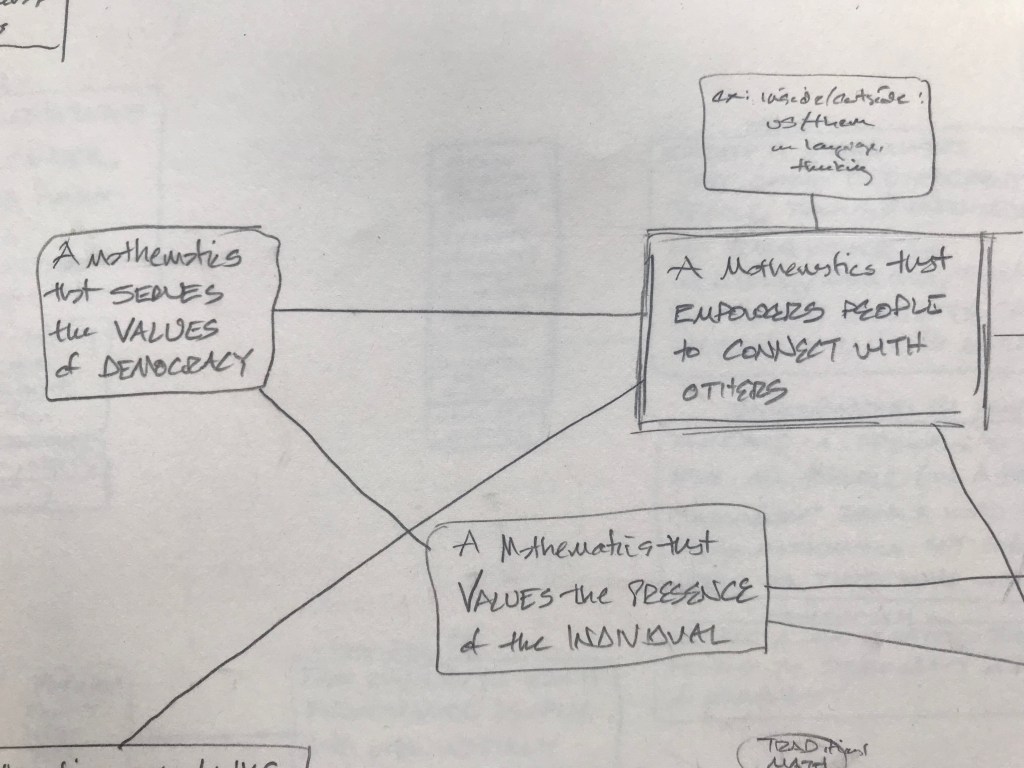
To me, these ideas have appeal because there is something democratic about them, that we are all, to a very large degree, the same. On the other hand, I find the idea that there is a correct, common-sense way of seeing things quite fascist. If such a way of seeing things and understanding them actually exists, then what is done with people who fail to see this way, or who don’t agree? Are they damaged? Is that why they can’t see what is “common sense”? Are they inferior? Do they need to be removed or put out of the way so that this”realistic conception of the world . . . . can come into existence”?
There is an attractiveness to many of us who were raised on values of democracy, a positive appeal we might feel of the statement “only when we acknowledge that to a very large degree we are all the same”. Yet when this “large degree” in which we are the same is confined by “common sense”, say, then I feel the alarms of fascism, the alarms that signal a standard to be met, and if unmet, a judgment against people, that can lead from disapproval to condescension to censorship to imprisonment to death in a few short years.
Truth is local. This is the truth of democracy. Truth is universal. This is the truth of fascism. Wherever there are people, they create their stories, their mythologies, their guiding models for how to act. They will argue, I suppose, and fight over these. Or not. The truths may feel eternal. People may want a belief that is everlastingly true. But this leads to fascism, as well, as it must certainly be noted, is the desire to make that statement, and/or the statement itself.
So the best we can do is to look at actual behaviors and judge the behaviors as being pro-democratic or not. The thoughts, the desires for absolute truth or certainty, possibly very normal human desires, possibly desires from a warped Euro-centric concern with certainty that goes back at least to Euclid, and not far enough back— at least to Socrates, put to death for corrupting the youth of Athens with arguments against their own “local universal”.
But ideas are stories that focus power. And power has been used to sustain power, since it is most easily generated by those who already have power. If the masses have power, they can create stories that sustain and grow their power. If an elite has power, they can make stories that sustain and grow their power. And on and on.
Alexander rides a line between democracy and fascism that frequently veers sharply into echoes of fascism, ideas that, if manifested, would lead to a society in which people who didn’t see things the way Alexander did would be outliers, at best, and inhuman at worst, that is, inferior or insane enough to be removed from the rest of us, out of our way, so that our clearly common-sense and clearly superior way of doing things can proceed without meaningless or ignorant obstacles.
Yet the desire for democracy to be universal is, essentially, a fascist desire. Those who don’t agree are considered demented or ignorant, need to be educated, etc. That is how I feel, personally. But I still see the fascist component of that desire for something in which everyone has to agree or suffer consequences of some sort, from teasing to exclusion to . . . . This is a paradox that has a form common to many other paradoxes. The desire for democracy is itself undemocratic. Or is it more like the beliefs and efforts required to build and grow democracy are essentially undemocratic? Yet why would we want to choose something non-democratic? Perhaps the forms of decision-making in democracy aren’t the most democratic yet, but can’t they be improved for better representation for minority groups, people without money or power, etc.? Why would we just give up on democracy and hand the keys to fascism, which would be worse, since any thought or expression felt to be undesirable by those in power could be squelched without any real effort.
So we must address the idea that we all are living in a fascist society now, posing as democracy. Our own perceptions of who holds the power will differ. White people, wealthy white people, corporations who donate to candidates and adjust laws, and create them, to help their own consolidation and growth of power, etc. Well, this world I am describing is more like the one I grew up in than the one that exists today. My ideas are already old-fashioned, obsolete, etc. The world has a whole new set of rules and dynamics that have changed everything since I was young. Maybe some of the older ideas might be found useful by children in the future, our children of the future. So that is part of why I write—to push forward some thoughts that might be helpful, in a very pragmatic sense, or in a less tangible way. Who can say how a few words here and there might help?



 Oblique Connection